
A luggage tag printed on standard paper is often torn off before even reaching the delivery belt. The choice of material, weight, and attachment method determines the actual durability of the document, much more than the design or color chosen. Here we detail the technical parameters for producing a reliable suitcase tag, from the source file to the attachment on the handle.
Weight, lamination, and attachment: the three survival parameters in the hold
Automated sorting systems at airports subject luggage to shocks, friction, and sometimes moisture. A tag printed on standard office paper cannot withstand this treatment.
The weight of the paper determines the mechanical strength of the tag. A sufficiently dense cardboard absorbs bending and tearing stresses better than a standard sheet. We recommend using thick paper, such as Bristol or cardboard, rather than regular paper.
Lamination extends the lifespan of the document. There are two options: a laminating pouch (if you have the device) or wide transparent adhesive tape applied to both sides. This second method, sometimes called home lamination, is more than sufficient for a round trip. It also protects inkjet ink, which is sensitive to water.
The attachment remains the most common weak point. A simple thread or string passed through a hole punched in the corner of the tag breaks under impact. A metal eyelet, applied with a tool, significantly strengthens the attachment. The alternative is to fold the tag around the handle and secure it with strong adhesive tape, eliminating the need for an eyelet.
If you are looking for a free printable suitcase tag in PDF with a minimalist and readable design, choose a model that leaves enough space to write with a permanent marker rather than a model overloaded with decorative patterns.
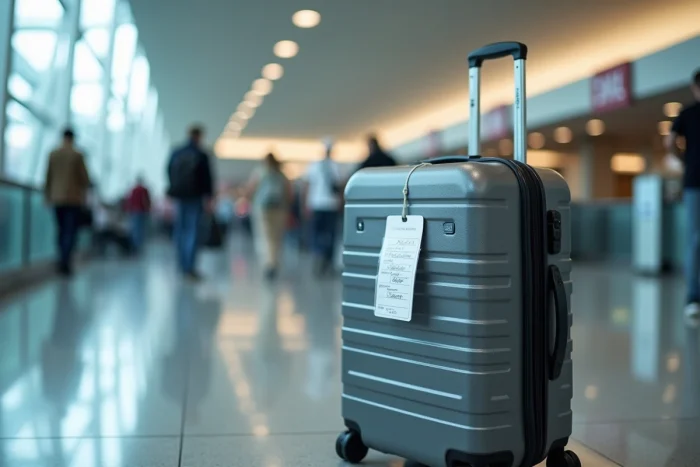
PDF, SVG, or PNG format: which file for which luggage tag
The file format determines what you can modify before printing. Most free templates are distributed in PDF, which is suitable for direct printing without editing. The PDF preserves the fonts, margins, and exact dimensions of the document.
Models available in SVG or EPS offer a different advantage: they are editable in vector graphic software (Inkscape, Illustrator) or in online tools like Canva. You can then modify the size of the fields, typography, and layout without loss of quality when printing.
The PNG format, on the other hand, is a pixelated image file. It works for printing at actual size, but any scaling degrades the sharpness of the text. For a tag that needs to remain readable from a distance on a conveyor belt, this compromise is rarely acceptable.
- PDF: direct printing, no modifications possible without dedicated PDF editor, consistent quality regardless of printer
- SVG/EPS: complete customization (fonts, fields, dimensions), requires vector software or a tool like Canva/Cricut
- PNG: suitable only for fixed-size printing, loss of sharpness when resizing
If you have no editing software, PDF remains the most reliable choice. If you want to adapt the model to a pocket format or add a custom QR code, opt for a vector file.
Contact QR code on luggage tag: real interest and limits
Some recent models include a QR code linked to an online contact sheet. The idea: the person who finds your luggage scans the code and accesses your contact information without it being visible in plain text on the tag.
The QR code protects your personal data while facilitating the return of the luggage. Your name, phone number, and address are no longer readable by anyone passing by your suitcase. Only the scan provides access to this information.
In practice, this approach has two limitations. The QR code must link to a page you control and that remains accessible throughout the journey. A link to a third-party service requiring registration may discourage the person who finds the luggage.
Moreover, not all handling or customer service agents have the reflex to scan a QR code. The tag must therefore always contain at least a name and a phone number in plain text, with the QR code serving as a supplement, not a substitute.

Home-printed luggage tag or self-service kiosk: what to choose
Airlines like Air France offer to print the luggage tag during online check-in, simultaneously with the boarding pass. The document can be printed immediately or sent by email for later printing.
Self-service kiosks at airports and some train stations also allow you to print boarding passes and luggage tags in seconds. This system reduces the appeal of proprietary laminated tags provided by carriers, as travelers can generate a document for each trip.
- Home printing: total control over the material (weight, lamination), ability to add a personal QR code, preparation ahead of the trip
- Airport/station kiosk: no need for a personal printer, standardized format, but no choice over the paper used
- Mixed tag: print the personalized model at home for identification, then add the carrier’s tag at the kiosk on the day of departure
The combination of both approaches remains the most reliable: a laminated personal tag with your permanent contact details, complemented by the carrier’s tag specific to the flight or journey. If the carrier’s tag comes off, your personal tag takes over.
Information to include on the tag
A minimalist model readable at a glance should contain five elements: name, first name, mobile phone number, email address, and destination city. The full postal address is optional and exposes your data more. Prefer a phone number reachable internationally if you are traveling outside France, adding the country code.
Writing this information with a permanent marker on a pre-printed model ensures better durability than inkjet printing alone, especially if the lamination is not perfectly waterproof. A ballpoint pen withstands water better than most consumer printer inks.