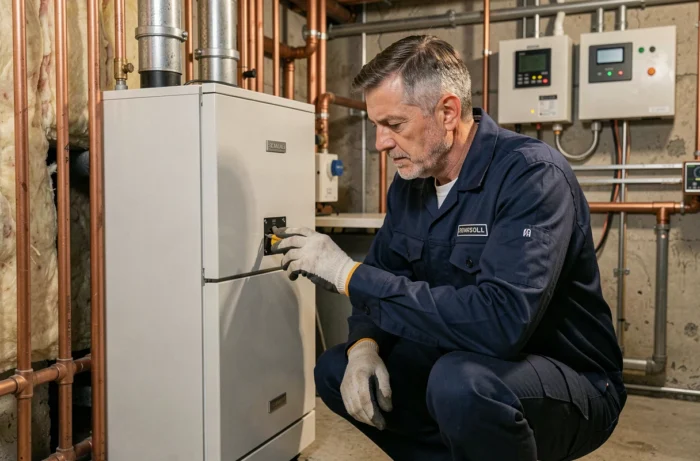
Pellet heating now accounts for a growing share of France’s residential housing stock. Between professional qualifications, maintenance requirements and financial assistance tied to the choice of installer, finding a reliable professional means knowing where to look and what questions to ask before even discussing equipment or a quote.
RGE certification and pellet heating: what the label really covers
The RGE designation (Recognized Environmental Guarantor) is often presented as a universal mark of competence. In practice, RGE certification must match the specific type of work being considered. A professional certified to install wood boilers is not automatically qualified to install a pellet stove, and vice versa.
To check that the certification is appropriate, the France Rénov’ public directory lets you search for a company by postal code and type of work. The listing specifies the qualification module, its validity dates and the certifying body. Before arranging an appointment, you can contact Chauffage Pellets for initial guidance on professionals listed in your area.
It is also worth asking the company for a copy of its RGE Qualibois certificate. This document lists the areas covered by the qualification and its validity period. If an installer is reluctant to provide it, take that as a warning sign.

Independent advice or sales advice: understanding the difference
An installer of pellet stoves or boilers sells equipment and labor. Their technical advice is valuable when it comes to how their products work, connecting them to the flue or sizing the pellet storage. However, their impartiality has its limits when comparing their solution with other heating systems or estimating the financial assistance you may be eligible for.
France Rénov’ advisors, part of the public energy renovation service, offer free guidance with no commercial ties. Their role is to assess the home as a whole (insulation, existing heating system and budget) before recommending a type of equipment. Getting independent advice first helps prevent an appliance from being sized solely on the basis of the seller’s product range.
Combining these two sources of information provides a more solid basis for making a decision. The France Rénov’ advisor carries out the energy assessment, and the RGE-certified installer turns it into a technical solution. If their recommendations differ, getting a second quote from another qualified professional makes it easier to compare like with like.
Quotes for pellet stoves or boilers: what to check
A clear quote should include more than a total price. Several details affect the quality of the installation and your eligibility for assistance such as MaPrimeRénov’.
- The exact appliance model, its rated output and efficiency, along with its certification reference (Flamme Verte or equivalent). Without this information, it is impossible to check whether the appliance qualifies for assistance.
- Details of the flue connection: whether a new flue will be installed, an existing one lined or an existing flue reused, along with the standards followed. An incorrectly sized flue reduces efficiency and compromises safety.
- The maintenance arrangements after installation. Chimney sweeping is a legal requirement, and failure to maintain the appliance can result in a fine of several hundred euros or even a refusal of insurance coverage in the event of a claim.
- Explicit confirmation of the company’s RGE certification, including its certificate number. This is required to access public assistance.
Comparing at least two detailed quotes against these criteria helps you identify differences in the work offered, not just the price. A more expensive quote that includes full flue lining and an annual maintenance contract may prove more economical over five years than a low introductory offer that excludes these services.
What a quote may not always tell you
Appliance sizing is based on assumptions: the area to be heated, insulation levels, target temperature and pellet storage capacity. Ask the installer to explain these assumptions in writing. If two professionals recommend very different output levels for the same home, their assumptions differ, and you need to understand why.
The quality of the pellets used also affects efficiency and how quickly the appliance becomes clogged. A good installer will specify the required fuel certification (ENplus A1 or equivalent) and adjust the settings accordingly.
Maintenance and chimney sweeping: requirements that affect your insurance
Installation is only the beginning. A pellet stove or boiler requires regular maintenance, some of which is governed by regulations.
The flue must be swept as often as required by the departmental health regulations, generally at least once a year. Without a chimney-sweeping certificate, your home insurance provider may refuse to cover damage in the event of a fire. The professional who sweeps the flue must provide a dated certificate, which should be kept with the home’s documents.
The appliance itself must be serviced annually by a qualified heating engineer. This includes cleaning the burner, checking for leaks and inspecting combustion. Some installers offer a maintenance contract when they install the appliance, making it easier to keep track of servicing. If they do not, noting the exact make and model will make it easier to find a qualified technician later.
Finding a reliable pellet heating engineer: where to look
General online directories list thousands of professionals, but they do not all verify that the qualifications shown are valid. Three channels offer more reliable screening:
- The France Rénov’ directory, which lists only companies with current RGE certification, verifiable by certificate number.
- Pellet appliance manufacturers, which maintain networks of approved installers trained on their specific products. Advice through these networks is brand-specific, but the installer’s technical expertise with the appliance is documented.
- Wood-heating forums and specialist groups, where other users’ experiences with local installers can supplement official information. The drawback is that published reviews are not systematically verified.
None of these sources alone can guarantee that a professional is reliable. Cross-checking the official directory with local firsthand feedback remains the most robust way to avoid unpleasant surprises, whether you are looking for an installer for your first appliance or a technician to service an existing pellet boiler.