
The market for payment solutions for professionals is undergoing a rapid restructuring phase. With the widespread adoption of integrated payments in business software, new regulatory requirements on accessibility, and pressure on transaction costs, companies are facing technical trade-offs that go beyond the simple choice of a terminal or a credit card.
Integrated payments in business software: what changes for companies
A fundamental movement is gaining momentum in continental Europe: the native integration of payment into the management tools that professionals already use daily.
Instead of switching to an external interface to process payments or settle transactions, payments are executed directly from the ERP, billing software, or vertical SaaS (construction, healthcare, retail). The growth of integrated payments is one of the most closely monitored dynamics by industry analysts.
Players like monetyk.fr are already offering professionals this type of approach, where payment management is seamlessly integrated into the business process without interface disruption.
This approach reduces friction for accounting teams and corporate buyers, two profiles for whom each additional step in a payment process generates lost time and data entry errors.
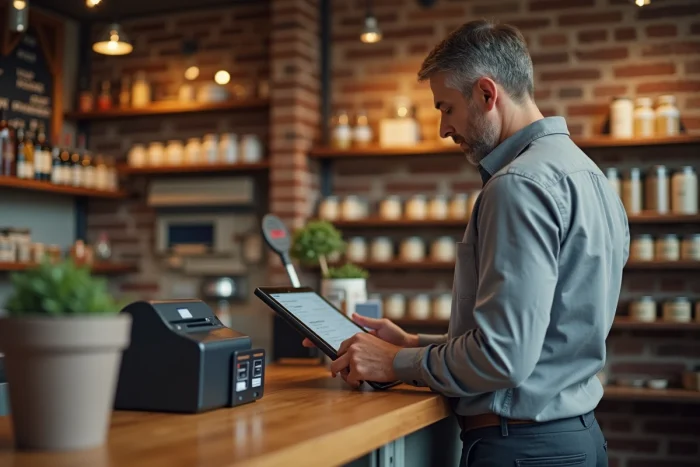
Accessibility of payment interfaces: an underestimated regulatory constraint
The European directive on the accessibility of products and services (European Accessibility Act), transposed into French law by ordinance n° 2023-859 of September 6, 2023, mandates that online payment services must be accessible starting June 2025. Screen reader compatibility, keyboard navigation, sufficient contrasts: the requirements are concrete and verifiable.
For companies using an electronic payment terminal or an online checkout, compliance is not just an image issue. There is a risk of litigation. PSPs (payment service providers) and software solution publishers are gradually adapting their B2B merchant portals and checkout pages.
Field feedback varies on this point: some companies find that their providers have already updated their interfaces, while others discover the issue during an audit. Checking the compliance of their current payment solution with the EAA is part of the trade-offs to be made now, before a competitor or a client points it out.
Card terminals, mobile terminals, and Mastercard: the criteria that really matter
The market for electronic payment terminals remains fragmented. Historical players like Worldline coexist with fintechs offering low-cost mobile terminals directly connected to a smartphone. The usual criteria (terminal price, transaction fee, Mastercard and Visa compatibility) are no longer sufficient to differentiate offers.
- The terminal’s ability to send transaction data in real-time to the management software or ERP, without manual export or intermediate CSV files
- Support for split or deferred payments in B2B, a recurring need for merchants and wholesalers managing significant receivables
- The level of customization of the customer payment journey (choice of payment method, card, instant transfer, payment by link)
- Compliance with the accessibility requirements mentioned above, including on the physical terminal itself
A terminal connected to the entire management chain significantly reduces accounting reconciliation time. This is the criterion on which recent solutions differ the most, not on the price of the hardware.

B2B Payments: why instant transfers are reshaping flows between businesses
Business-to-business commerce represents colossal volumes but remains dominated by manual processes for a significant portion of transactions. Instant transfers and payment by link change the game for retailers targeting a professional clientele.
The role of the corporate buyer, internal validation circuits, and treasury management hinder the adoption of fast electronic solutions. These organizational constraints largely explain the delay of B2B compared to B2C in terms of dematerialized payments.
Instant transfers lift some of these barriers: the supplier receives funds within seconds, improving their cash flow without resorting to factoring. Payment by link, sent via email or SMS, allows bypassing cumbersome order forms.
The available data does not yet allow for precise measurement of the adoption rate of instant transfers in B2B in France. However, the trend towards the digitalization of inter-company payments is accelerating, driven by the pressure from financial departments seeking to reduce collection times.
Security and fraud detection in professional payment solutions
The rise of electronic payments is accompanied by a sophistication of fraud attempts. For companies processing a high volume of transactions, real-time fraud detection is a non-negotiable selection criterion.
Recent solutions incorporate behavioral analysis algorithms that evaluate each transaction based on dozens of parameters (geolocation, purchase history, amount, frequency). Some platforms allow merchants to define their own blocking or enhanced verification rules.
A point of caution: the management of false positives remains a concrete problem. Blocking a legitimate transaction from a loyal professional client is costly in business relations. Companies choosing a payment solution must demand clear indicators on the false positive rate, not just on the detected fraud rate.
The choice of a payment management solution for a professional activity is no longer limited to comparing pricing grids. Regulatory compliance, integration into existing business tools, and the quality of fraud detection now weigh as heavily as the price of the terminal or the card fee. Companies that neglect these criteria expose themselves to hidden costs far exceeding the savings made on a monthly subscription.