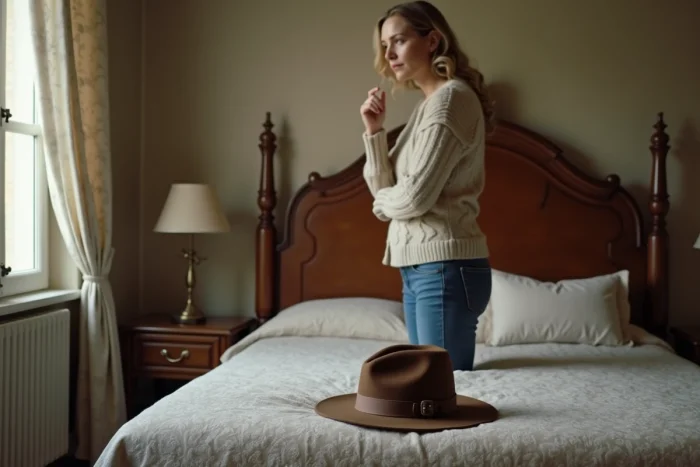
An abandoned hat on a bed brings forth a whole world of fears. This unwritten rule, inherited from the past, has traversed centuries without wavering. Placing one’s hat on the duvet is not merely an innocuous gesture: the taboo still circulates, wrapped in warnings, as if fate were lurking for those who would disregard it. Misfortune, illness, and sometimes even death are mentioned. Rarely questioned, these beliefs draw from a common heritage where funeral rites, hygiene precautions, and social codes weave a tight web. While the precise details of their origin fade, the fear remains, transmitted, adaptive, embedded in our daily rituals.
Superstitions Surrounding the Hat: An Overview of Popular Beliefs
It’s impossible to put a hat on the bed without reviving this discomfort that crosses borders. Italy, Portugal, Scotland: throughout Europe, the rumor spreads. This gesture, reputed to bring bad luck, has propagated over the centuries. It is said that in the past, during funeral vigils, the hat of the doctor or priest was placed on the bed of the dying. The symbol has made its way and left its mark in collective memory. The fear has been transmitted, from mouth to ear, transforming a simple habit into a tacit rule.
Variations abound depending on the country. In Scotland, for example, it is enough for the hat to touch the bed to stir unrest in the house. Other regions have shifted the superstition: bread overturned on the table, headgear placed in the wrong spot, everything becomes an excuse to ward off bad luck. These daily gestures carry a meaning that transcends the object itself. This touches on a sensitive relationship with the invisible, rooted in collective history.
The hat, seemingly mundane, resonates with other codes. Clothing intended to attract success, the colors chosen to promote fortune: red in China or India, white during Brazilian celebrations. This accumulation of symbols reflects a long-standing desire to divert chance. But the superstition of the hat on the bed remains unique, like a warning that one prefers not to challenge.
Fashion designers are well aware of these references. They sometimes play with them, embroider around them, slipping a few discreet allusions into their collections. Proof that, behind style, heritage continues to play its part down to the smallest detail of our daily gestures.
Why Associate This Gesture with Bad Luck?
The mere sight of a headgear placed on the bed brings back an old fear. Originally, it was funeral rites that forged this belief. When doctors or priests came to the bedside of a dying person, they left their hat on the bed. The gesture eventually came to symbolize the encounter with death. This passage has left lasting traces: the hat abandoned on the duvet is then perceived as a signal of ill omen.
The bed, the centerpiece of the home, concentrates a part of mystery. We sleep there, confide in it, rest on it. Placing an accessory from the outside, especially a hat, seems to transgress a boundary. Other taboos fit into this logic: breaking a mirror, opening an umbrella indoors, crossing paths with a black cat… These are all gestures that transgress domestic order and evoke a fear of retribution from fate.
Various countries express these superstitions, here are some notable examples:
- In several French or Portuguese households, the prohibition of hats or even overturned bread at the table is part of customs to be respected without hesitation.
- In Scotland, placing a hat on a bed remains one of the most persistent domestic taboos even today.
Over the ages, all these practices have woven into a true network of signs and ritualized gestures. Despite modernity, the fear of bad luck or disorder continues to fuel these silent traditions, faithfully preserved.

From Tradition to Today: The Persistence of an Old Reflex
If this superstition endures, it is because it speaks to a deep anxiety. Across Europe, the directive still permeates habits, in families but also in the world of fashion. It is surprising to see how many hesitate today to place their hat on the bed, proof that the old omen is resilient, even beneath the surface.
Fashion also does not hesitate to reinvent these codes, blending superstitions and ancient references in creations that play with symbols. Wearing a lucky garment, donning a specific color at the right moment: everyone appropriates these traditions to reassure themselves, or to challenge fate in their own way. The textile industry readily recycles these stories, giving each detail a double meaning, between aesthetics and superstition.
Examples of associated rituals number in the hundreds across Europe. Here are some telling practices:
- Touching wood to ward off bad luck, avoiding certain types of gifts, stepping through the door with the right foot during a wedding: all examples showing how much the collective shapes us.
- Some garments retain symbolic value, inherited from the past or family traditions, which we carry for the moments that truly matter.
These beliefs go beyond mere anecdotes. They reveal a persistent need to make sense of the uncertain and to tame the unexpected. Sometimes, it takes just a well-placed accessory, a precise gesture, to feel that luck is turning in the right direction. Change a little, and everything seems possible. Nothing says that one day, the habit won’t fade away. But for now, the headgear remains at a safe distance from the duvet, like a discreet guardian against unpleasant surprises.