A corporate photo rally is built around a simple format: teams, a defined area and visual challenges to complete within a set time. The concept may seem straightforward, but the quality of the event depends on factors that most planning briefs underestimate, from the legal framework for image rights to the right balance of creative challenges.
Image rights and GDPR: the legal framework for a corporate photo rally
Taking a photo of an employee and sharing that image are two legally distinct acts. Taking part in a photo rally does not constitute permission to publish photos on the intranet, social media or internal communications materials.
The employer–employee relationship complicates the notion of consent. The CNIL considers consent to be freely given only if refusing has no impact on working conditions, pay or career progression. In practice, providing a no-photo option for participants who decline (such as a dedicated area or a role on the judging or logistics team) makes that choice tangible and enforceable.
The company that determines why and how photos are taken remains responsible for processing the data, even when it hires an external provider. The photographer or event host must receive documented instructions covering the purposes of processing, recipients, retention period and the rights of the people concerned. We recommend setting out these points in a document given to participants before the rally begins.
Organizing a photo rally activity for team building with a specialist provider makes this easier to manage, as permissions and GDPR compliance are included in the service.

Planning the route and balancing photo challenges
The route sets the pace of the activity. An area that is too large spreads teams out and reduces interaction. An area that is too small creates bottlenecks at the same points of interest.
Define the playing area
In an urban setting, a few blocks are enough for a one- to two-hour session. On private grounds (a campus or corporate park), the route can be marked using visual landmarks or GPS coordinates built into a dedicated app.
Check the route’s accessibility on site in advance, not on a map. Slopes, stairs, uneven surfaces and narrow paths: any obstacle that goes unnoticed could exclude a participant with reduced mobility. A physical walkthrough the day before or on the morning of the event is still the most reliable approach.
Balance creative difficulty with technical demands
Photo challenges fall into three categories:
- Observation challenges: find an architectural detail, a pattern or a specific color. These encourage the team to pay attention together and can be completed quickly.
- Staging challenges: recreate a pose, tell a story in a single image or include every team member. These call for coordination and discussion within the team.
- Technical challenges: experiment with perspective, reflections or natural light. These give creative participants a chance to shine without requiring professional equipment; a recent smartphone is enough.
Mixing all three categories keeps the activity varied. A rally made up entirely of observation challenges becomes a standard treasure hunt. One made up exclusively of creative challenges can frustrate participants who are less comfortable with photography.
Team composition and group dynamics in a photo rally
Teams of four to six people create the best group dynamic. With fewer people, the cognitive load on each participant becomes too high and stress can overshadow the fun. With larger teams, some members may disengage.
Mixing employees from different departments is the main way to build cohesion. Bringing together different departments, seniority levels and lengths of service encourages people to interact in new ways. A common mistake is to let participants form their own teams: they naturally regroup with their usual colleagues, undermining the team-building effect.
Assigning rotating roles within each team (photographer, navigator, art director) prevents one person from monopolizing the camera. This rotation has an added benefit: it brings out skills that may not be used in the usual workplace setting.
Scoring criteria and group review of the photo rally
The review session shapes what participants take away from the activity. Without it, the photo rally remains a one-off diversion. With a structured review, it becomes an opportunity for mutual recognition.
Announce the scoring criteria before the rally begins. Teams can then adapt their strategy to the criteria: originality, adherence to the theme, composition and visible team spirit in the image. A mixed judging panel (the organizer, photographer and volunteers from among the participants) helps minimize disputes.
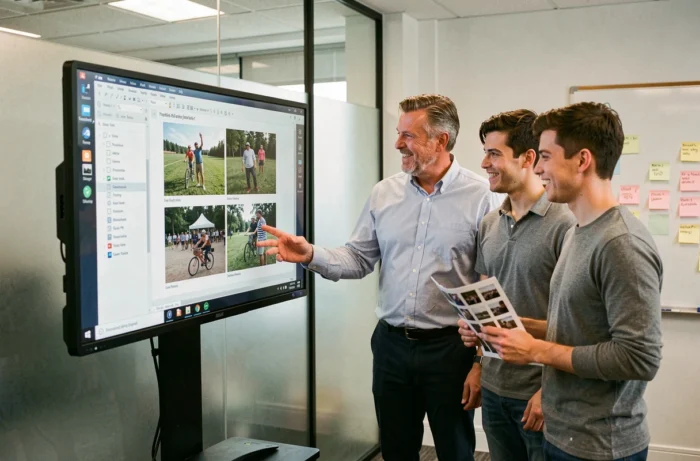
Projecting the photos on a large screen and commenting on them live is the highlight of the event. Each team presents its three best shots and explains its choices. This format sparks spontaneous discussion and extends the sense of connection well beyond the rally itself.
Make use of the photos after the event
Photos taken during a corporate photo rally are a valuable internal communications asset that is often wasted. A shared intranet gallery, a temporary exhibition at the workplace or a feature in the newsletter: these follow-up activities only work if permission to share the images has been obtained in advance, with the intended channels clearly specified.
Set a retention period for the images and communicate it to participants to properly close out the GDPR process. Without this step, photos may circulate indefinitely on servers without a clear legal basis.
A corporate photo rally works because it combines creative constraints, moderate time pressure and teamwork on a tangible deliverable. Success depends less on the budget than on careful planning: a tested route, balanced challenges, transparent rules and treating image rights as a prerequisite, not a last-minute formality.