Choosing a grass variety to achieve a green garden year-round involves considering several parameters that traditional guides rarely address together: soil type, exposure, land use, as well as the available water source and the watering restrictions in your municipality. This last factor radically changes the situation, as a water-demanding grass becomes unusable as soon as a prefectural order prohibits watering lawns.
Watering Restrictions and Grass Selection: The Overlooked Parameter
The promise of a green lawn twelve months a year faces a regulatory reality. In France, drought levels defined by prefectures can completely prohibit lawn watering as soon as the “crisis” level is reached. Even at the heightened alert stage, the allowed watering times are significantly reduced.
Before comparing grasses, the first step is to consult the VigiEau system and the prefectural order for your watershed. These documents specify restrictions based on the water source (public network, private well, rainwater harvesting). A water-hungry variety can become out of play even in a temperate climate if your department imposes recurring restrictions.
To identify the best grass to sow according to Jardindivert, it is essential to integrate this regulatory criterion alongside soil type or sunlight exposure.
The reuse of treated wastewater for irrigating green spaces has been legally recognized since the order of December 14, 2023, but it requires a prefectural authorization and a health assessment. This is not a solution accessible to individuals without prior steps.

Grass Varieties: Comparative Table by Resistance and Use
Seed mixtures combine several species to compensate for the weaknesses of each. The table below summarizes the characteristics of the most common grasses in lawns sold in France.
| Grass | Drought Resistance | Traffic Resistance | Shade Tolerance | Germination Speed | Leaf Fineness |
|---|---|---|---|---|---|
| Tall fescue | Very good | Good | Average | Average | Medium to coarse |
| Creeping red fescue | Good | Poor | Very good | Slow | Fine |
| Perennial ryegrass | Poor | Very good | Poor | Fast | Medium |
| Meadow fescue | Average | Very good | Average | Slow | Fine to medium |
| Sheep fescue | Very good | Poor | Good | Slow | Very fine |
This table highlights a clear gap. No grass combines all resistances at once. This is why commercial seeds are always mixtures, with different ratios depending on their intended use.
Tall Fescue vs. Perennial Ryegrass: Two Opposing Strategies
Tall fescue and perennial ryegrass illustrate two radically different strategies. Perennial ryegrass germinates quickly and withstands intensive foot traffic, making it suitable for family gardens with children or pets. However, its low drought tolerance makes it vulnerable as soon as watering is limited.
Tall fescue develops a deep root system that allows it to draw water from deep in the ground. It tolerates heat and poor soils. Its coarser foliage does not provide the aesthetic appearance of fine ornamental grass.
For a garden exposed to full sun in an area regularly subject to water restrictions, a mixture dominated by tall fescue offers a better chance of summer greenness. Conversely, a shaded and well-irrigated area benefits from a mixture rich in creeping red fescue, whose fine foliage and shade tolerance compensate for its low traffic resistance.
Summer Dormancy: An Underestimated Asset
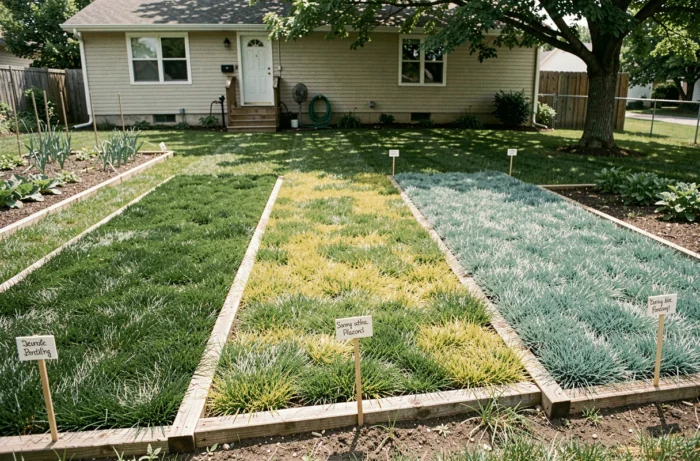
Some grasses enter dormancy and turn yellow without dying during dry periods. Tall fescue and sheep fescue regain their green color as soon as the rains return. This dormancy capability is a criterion to prioritize if the goal is the longevity of the lawn rather than constant greenness in the height of summer.
Opting for a lawn that tolerates dormancy allows compliance with watering restrictions without the risk of having to reseed every autumn.
Grass Selection Criteria Based on Soil and Exposure
Beyond climate and water, three parameters guide the choice of seed mixture:
- Soil type: clay soil retains water but compacts, favoring tall fescue. Sandy soil drains quickly and is suitable for perennial ryegrass if watering is possible, or for sheep fescue in dry conditions.
- Exposure: shaded areas (less than four hours of direct sunlight) require a mixture rich in red fescues. Full sun areas lean towards tall fescue or meadow fescue.
- Intended use: an ornamental lawn that is rarely walked on can contain a high proportion of fine fescues. A play or relaxation lawn requires perennial ryegrass or meadow fescue for their resistance to repeated traffic.
The quality of the seeds is as important as the choice of variety. Professional mixtures generally have a higher germination rate and purity than entry-level products. Checking the label on the bag (species, proportions, germination rate) helps avoid unpleasant surprises.
Grass and Minimal Maintenance: Adapting Mowing and Fertilization
A well-chosen mixture reduces maintenance but does not eliminate it. The mowing height directly influences the grass’s resistance to drought. Mowing too low exposes the roots to sunlight and accelerates evaporation. Maintaining a more generous cutting height in summer protects the soil and limits the need for watering.
Fertilization should remain moderate. Excessive nitrogen input stimulates leaf growth at the expense of roots, weakening the lawn under water stress. A balanced fertilizer, applied in spring and early autumn, is sufficient for most mixtures.
- Mow at a height suitable for the season (higher in summer, shorter in spring and autumn)
- Scarify once a year to aerate the soil and limit thatch
- Prefer deep and spaced watering rather than light daily watering, when regulations allow
The choice of grass variety is not just a botanical question. Local water constraints, soil type, and land use form a decision triangle. A mixture dominated by fescues, capable of summer dormancy, remains the most reliable compromise for a lawn that endures summers without systematic reseeding.