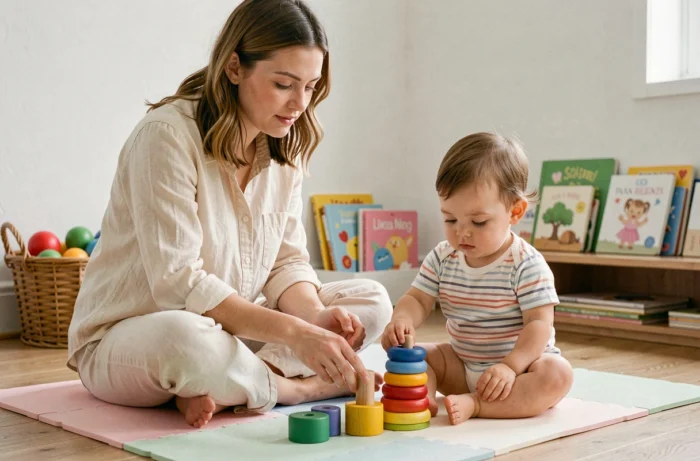
A child’s development is often measured through age milestones: walking at twelve months, forming first words around eighteen months, stacking blocks at two years. These milestones, useful for professionals, do not reflect the reality of all developmental paths. Supporting daily awakening first requires understanding that each child progresses at their own pace, and that deviations from traditional milestones do not always indicate a problematic delay.
Atypical Development: Identifying a Deviation Without Dramatizing
The developmental grids provided in health records or parenting guides describe statistical averages. A child who does not babble at nine months or who does not walk at fifteen months may simply be at the higher end of the curve, without any underlying disorder being involved.
The real warning sign is not a temporary gap in an isolated skill. It is the prolonged stagnation in several simultaneous areas (motor skills, language, social interaction) that justifies a specialized consultation. A child who progresses slowly but steadily is on a different trajectory, not necessarily concerning.
Inclusion and the identification of developmental gaps are now more integrated into professional early childhood frameworks. Since the publication of a national quality framework for the care of young children in July 2025, care structures have a common framework structured around the relationship with the child, the relationship with parents, and the organization of care.
This document encourages systematic observation of practices and their effects, placing awakening in a broader context than just a simple list of activities.
When doubt persists, the primary contact remains the family doctor or pediatrician. They can refer to a psychomotor therapist, a speech therapist, or an early medical-social action center depending on the area of concern. Many parents also find concrete support in Future Maman’s child resources to better understand developmental stages and adjust their expectations.
Daily Sensory Awakening: Leveraging the Environment Rather Than Materials
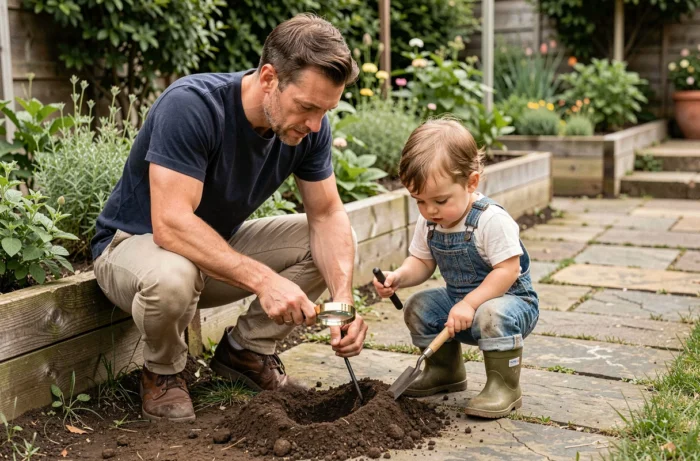
Sensory learning does not require “Montessori” labeled toys or structured workshops. The home environment already offers a wealth of stimuli that the child naturally exploits as soon as they are given access.
Touch is developed with what is already there: the texture of a sponge fabric, the coolness of a metal spoon, the roughness of a crust of bread. Varying the objects the child manipulates throughout the day stimulates tactile discrimination much more effectively than a sensory panel used once a week.
For hearing and language, the parent’s voice remains the most powerful stimulus. Naming objects, describing what is being done during a diaper change or meal preparation, commenting on street noises from the window: these micro-interactions build the child’s passive vocabulary long before they utter their first words.
- Offer objects of varied textures during quiet times (wood, fabric, corrugated cardboard) to enrich touch without specific purchases
- Allow the child to handle containers of different sizes during bath time to explore notions of volume and capacity
- Alternate sound environments: moments of complete silence, soft music, outside noises, to refine auditory perception
The goal is not to multiply stimuli but to give the child time to explore each sensation. A baby who turns the same object for ten minutes is not “doing nothing”: they are building complex neural connections.
Parental Technoférence and Quality of Interactions
Debates about screens often focus on the time a child spends in front of a television or tablet. A less discussed angle concerns the use of screens by adults in the presence of the child. This phenomenon, referred to as technoférence, denotes the interruption of parent-child interactions caused by the parent’s smartphone or computer.
Specifically, a parent checking their phone during meals or play reduces the frequency and quality of verbal and visual exchanges. The child senses this decrease in attention and may gradually reduce their attempts at communication, which slows down language development and emotional regulation.
Recent recommendations downplay the idea of an automatic cognitive effect of screens on children. The determining factor is the quality of parental presence, not just the timing of screen time. A parent fully available for twenty minutes has a more structuring effect than an hour of shared play interrupted by notifications.
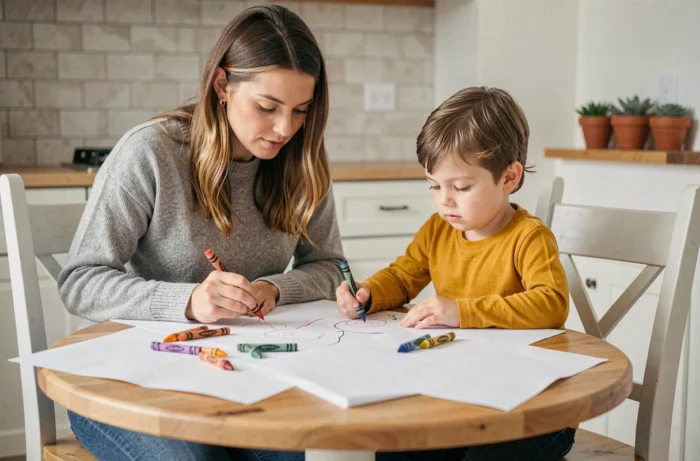
Some simple adjustments can change the situation:
- Turn off non-urgent notifications during care and play times (meals, bath, reading)
- Place the phone in another room during free play time to eliminate the temptation to check it
- Reserve checking messages for defined time slots, when the child is sleeping or being cared for by another adult
Child Autonomy: What “Accompanying” Really Means
Supporting development does not mean directing every activity. Autonomy is built when the adult observes before intervening. A child attempting to climb stairs, put on a sock, or open a box develops fine motor skills, problem-solving abilities, and self-confidence, as long as we do not do the action for them.
The adult’s role is to secure the environment and then remain in the background. If the child fails, waiting a few seconds before offering help helps preserve their motivation. If they succeed without intervention, the satisfaction gained reinforces their perseverance for future attempts.
This posture requires constant adjustment, as the zone of autonomy evolves quickly. What was inaccessible last week can become mastered in a few days. Regularly observing what the child is trying to do by themselves provides a more reliable indication of their developmental stage than any standard age grid.
A child’s awakening cannot be scheduled like a timetable. It thrives on a rich environment filled with varied objects, an adult attentive to their signals, and sufficient space to try, fail, and try again. The national framework published in 2025 confirms this at the level of collective structures: the quality of care is primarily measured by the quality of the relationship, not by the number of activities offered.