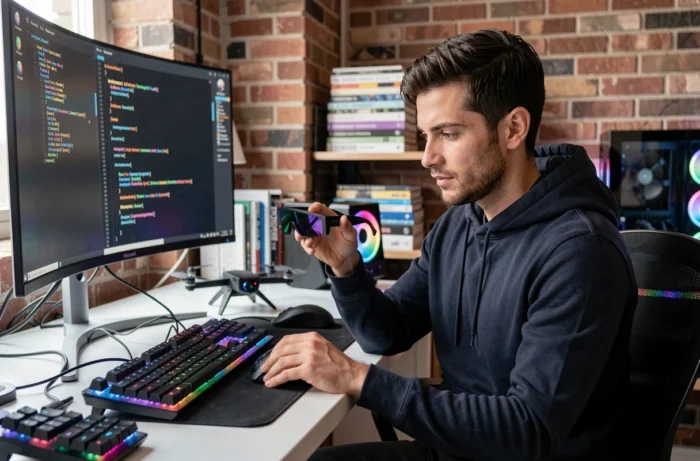
On-device AI, the European Cyber Resilience Act, and the rise of software agents are redefining what it means to be a tech enthusiast in 2026. The geek and high-tech trends of this fall are not just a list of gadgets: they reflect a technical shift whose effects impact both hardware and software ecosystems.
On-device AI: local processing replaces the cloud
Processing AI models directly on hardware is the most significant technical breakthrough of the year. Announcements made at IFA 2026 confirm that manufacturers, from laptops to home appliances, are now integrating NPUs (Neural Processing Units) capable of executing inferences without relying on a remote server.
Three concrete consequences for enthusiasts:
- Reduced latency and offline operation: a voice assistant or photo editing tool responds without depending on network bandwidth, radically changing the mobile experience.
- Enhanced privacy: data (voice, images, texts) remains on the device. For a geek user concerned about data sovereignty, this is a strong argument against cloud-only solutions.
- Software autonomy: model updates can be deployed locally, without a publisher unilaterally deciding to change the server-side behavior of the AI.
We observe that this trend is pushing component manufacturers to differentiate their ranges not just on raw frequency, but on the power of the integrated NPU. For informed buyers, the number of TOPS (Tera Operations Per Second) of the NPU becomes a selection criterion on par with RAM or storage.
Enthusiasts looking to explore the world of connected objects and geek hardware can visit the Geek Eshop website to find accessories compatible with these new architectures.
Cyber Resilience Act: what the European regulation changes for connected objects
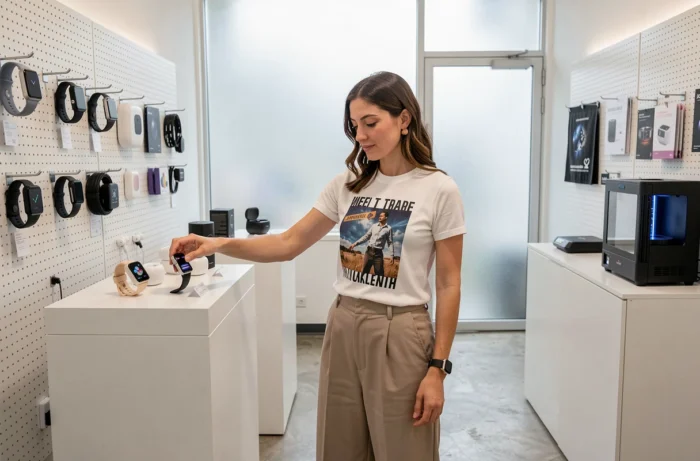
Since September 11, 2026, the first operational obligations of the Cyber Resilience Act (CRA) apply to products with digital elements sold in the European Union. Manufacturers must now quickly report actively exploited vulnerabilities and notify security incidents.
For a high-tech enthusiast, this changes the purchasing criteria. A cheap connected object without documented security tracking becomes a regulatory risk as much as a technical risk. Brands that do not publish a clear update policy expose themselves to sanctions, which should ultimately clean up the market for low-cost IoT gadgets.
Criteria to check before buying a connected object in 2026
We recommend systematically checking if the manufacturer announces a software support duration, if they have a vulnerability reporting channel, and if the product has undergone a compliance assessment with the CRA. A connected object without an update policy is now a warning signal, not just an inconvenience.
This European regulatory requirement also creates an advantage for brands that prioritize transparency. The most technical enthusiasts will see an opportunity: to favor open ecosystems where the firmware is auditable rather than locked black boxes.
Software agents and applied AI: beyond the gadget
The McKinsey 2026 report identifies agentic software development among the emerging fields. In simple terms, AI agents capable of executing complex tasks autonomously (writing code, managing workflows, analyzing scientific data) without human intervention at every step.
For geeks, this trend translates into new tools usable in everyday life. Development environments integrate agents capable of debugging, refactoring, and deploying code. AI for scientific discovery and engineering is also advancing, with concrete applications in material simulation or experimental data analysis.
Robotics and AI infrastructures: the investments that matter
The same report notes that robotics and AI infrastructures are expected to receive significantly more investment in 2026 than in 2025. This translates into an expanding hardware offering: programmable robotic kits, AI development boards, and model training platforms accessible to individuals.
The interest for an enthusiast lies not in the toy robot, but in the ability to experiment locally with AI models on affordable hardware. Consumer-grade graphics cards now support local inference frameworks that would have required a server cluster two years ago.
European digital sovereignty: an underestimated geek issue
Europe is multiplying initiatives to reduce its dependence on foreign technologies. This debate, often perceived as purely political, has direct repercussions on the products available. Discussions around a European digital majority, calls to regulate AI, and tensions between regulation and innovation shape the tech offering accessible to European consumers.
High-tech enthusiasts are the first to be affected by these trade-offs. A stricter regulatory framework may delay the arrival of certain products in the European market, but it can also promote the emergence of local alternatives, particularly in the field of voice assistants, sovereign cloud services, and networking hardware.
Keeping track of these regulatory developments is now part of technological monitoring, just like monitoring the benchmarks of a new processor. The geek and high-tech trends of 2026 are no longer limited to hardware: they include the legal framework that determines what this hardware can do, and for how long it will be maintained.